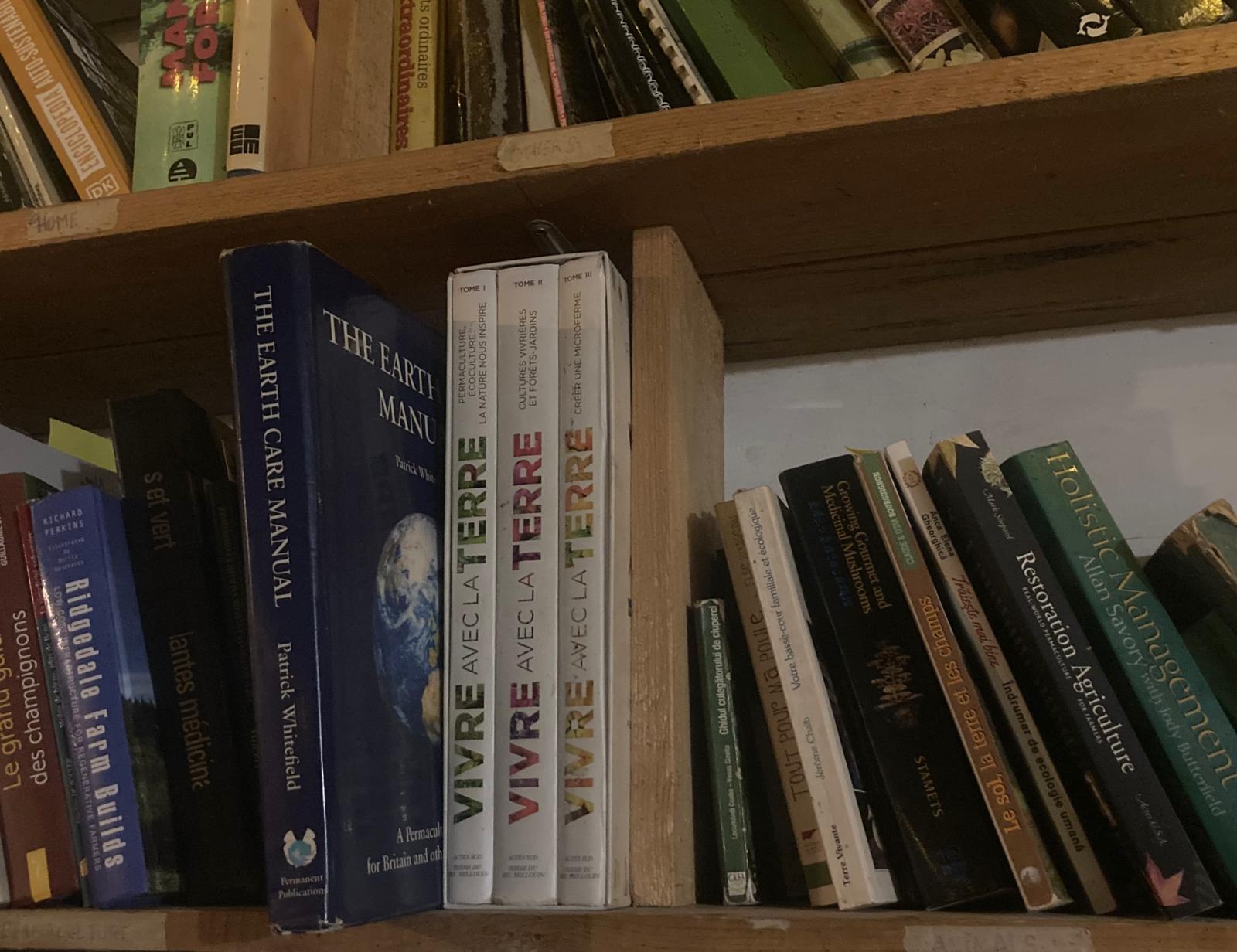
As we know, winter is the season for physical and emotional rest, introspection and care. A radical act of care and support for oneself and the community is learning: dedicating resources and time to the process of acquiring meaningful information builds on self-reliance, opens roads and perspectives onto the existing World, drives informed and sensible change in our systems and dynamics, and eventually fosters occasions for indipendently-led and horizontal sharing in our communities and circles. Reading has always been dear to my heart, so I’ve started the deep-dive into Permaculture with a book called “The Earth Care Manual” (2004) by author Patrick Whitefield, one of the pioneers in the European Permaculture landscape, whose previously mentioned book is to find in Ermitaj’s library.
Structure and topics
One feature I appreciated about the Earth Care Manual is its structure: quite logical, progressive and easy to follow, while at the same time appropriate for sparse consultation on the different topics, should a specific curiosity arise in any of the areas developed in the book. Moreover, accessibility for people approaching the subject for the first time is enhanced by the presence of a glossary, notes and a comprehensive index of scientific and common names of the plants mentioned. Possibilities for further reading are also offered, alongside a list of organisations which could be of interest in the setting up of a collaborative Permaculture project, especially in the urban Environment.
A very wide variety of topics is touched, starting from an introduction into what Permaculture is and its principles, reaching methods and practices for Permaculture design. The book is composed of three parts, titled respectively “Basics”, “Applications” and “Designing”. In this division I can see the shadows of the principle of designing “from pattern to detail”: at the beginning we’re given an overlook of ethics and broader natural phenomena and their interactions, such as soil, water, energy and climate. These are forces and elements that mould every place on Earth, and through their interactions give each its own characteristics. After this, the analysis passes to the built environment, handling buildings, agricultural systems, food links and the impact of human activity on biodiversity. In the conclusive pages, the Permaculture design process is outlined in its characteristic methodological features and practical steps.
Practical takeaways from The Earth Care Manual
A wide variety of practical insights are given in the book, which may be also applied to our local context at Ermitaj, as well as in any garden. Key takeaways for me have been:
Integration animals as part of the garden ecosystem
Permaculture is very much about noticing existing relationships, fostering them, and eventually bringing them to beneficial use inside our sphere of influence. It emerges from the book that animals, especially chickens, interact in an multitude of great ways with other elements in the garden. For instance, the are surprisingly good at controlling population of several pests and weeds, such as slugs, they provide cultivation in the superficial layer of the soil – with the technique of the chicken tractor, their manure can add to the organic matter content of the soil, and they can make use of household kitchen scraps as part of their food intake – while also providing nutritious food as eggs or meat.
Many common animals can intertwine this kind of relationships to garden and household elements, some notable ones include: bees for enhancing and promoting local biodiversity and geese, who, similarly to the chickens, predate on pests and are natural grazers.
Good reasons for no-till agriculture
Quite some emphasis is put on exploring arguments that counter or favour tillage in agriculture of all scales. As a novice to the topic, I found the explanation to be balanced on both sides of the dispute, while especially reasoning with some of the points made against turning the soil. Broadly speaking, alternative methods reduce the risk of soil erosion, act against compaction, contribute to a balanced breakdown of organic matter through the ethylene cycle and improve structure and biodiversity in the long run.
No-dig practices are gaining popularity in the sustainable agriculture scene, with prominent figures like Charles Dowding doing divulgative and educational work, and Permaculturists experimenting and adapting no-dig methods to their own specific geographical circumstances. All in all, this is a very broad topic, with causes and consequence that go well beyond what is visible to the human eye, worth exploring in greater detail to understand more intimately the mechanisms of the soil, the very element that supports and nourishes life on our planet.
Importance of following natural patterns
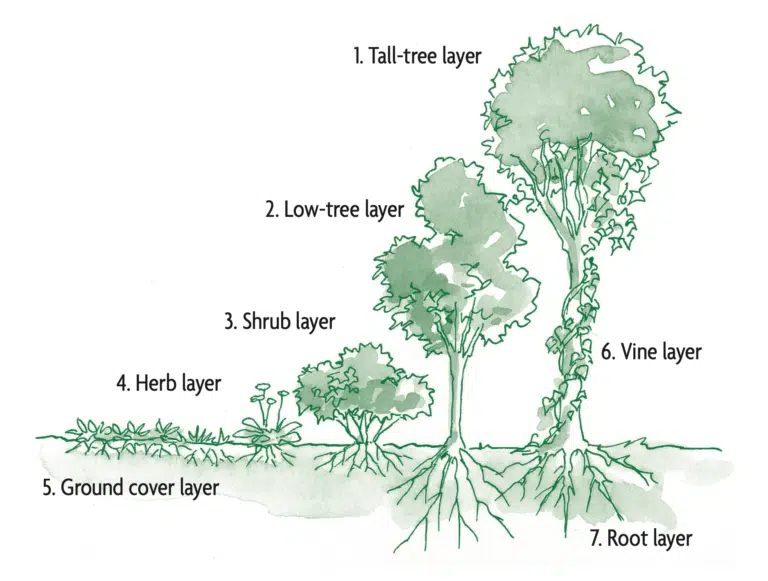
An interesting concept underlying the whole book is the importance of coherence to the natural patterns, in particular preserving the native biodiversity through privileging the choice of traditional seed and plant varieties in the design of our gardens. Another way we can design food systems in harmony with natural patterns is practicing agroforestry, especially following the forest garden model. Many are the factors to be taken into consideration (inputs, outputs, scale, soil, climate…) while pondering if a forest garden is the appropriate option for the local context: it’s not always an immediate or suitable. However, it is remarkable in its embodiment of a number of key practices central to Permaculture, such as the use of perennial plants, mulching, polyculture and stacking. Another praiseworthy characteristic of this approach is the fact that many niches are filled, therefore biodiversity and productivity are potentially high, when it’s based on thoughtful design.
Observation and recognition of site specific microclimates
Something I was unaware of was the notion of microclimate, and the fact that it can be very specific to the very location of a garden, farm or household, as well as change even between adjacent properies. In fact, a single land can reveal many different microclimates, which are to be identified through land survey during the whole year and careful observation. Main characteristics in assessing microclimates are: wind, sunshine, temperature, frost and moisture.
Hints on energy consumption
The chapter on energy brings about a change in the way our society mainly relates to energy consumption. Emphasis is put on the reduction of our initial consumption, as in refraining from producing or buying excess goods, more than on the repurposing and recycling processes, which can be energy intensive. This instills a benign doubt in the back of the reader’s mind, to question and assess the pros and cons regarding their consumption patterns. Embodied energy is also an insightful concept, however difficult to calculate it may be. It prompts us to reflect and inquire about the supply chain of the products the markets provide us with.
Conclusions
Above all, what is most remarkable is the paradigm of thought that the author conveys with his analysis: an abyssal shift is made from the industrial and profit-oriented way of picturing interactions between the animal and vegetal kingdoms. A base is laid for an empathic systemic thinking, oriented to conservation of present resources and best use of them, through the practice of Permaculture principles: observation lays the foundations of this approach, questioning and intentional action carry it forward. The Earth Care Manual recenters the human drive of tending to the Earth, putting it into a modern-world perspective, where dynamicity and plurality characterise our lives, giving rise to all the different contexts for regeneration and co-creation.
Throughout the whole exposition the tone is clearly encouraging, highlighting the importance of integrating into our lives the new ways of influencing the relationships we’re part of, and taking initiative to involve the broader community into the collective effort towards a conscious and truly ecological future.