
We live in a strange time. Scientific data has never been so precise, so accessible, so alarming. And yet the systems we live in continue to function as if nothing has changed. This article is an attempt to explain where we really stand, why it is so difficult to act at the scale the situation demands, and how, faced with all of this, permaculture offers something rare : an accessible framework, concrete tools, and the possibility of acting without waiting for the world to change first, each of us at our own scale.
1972 : the day nobody wanted to listen
More than fifty years ago, a group of researchers commissioned by the Club of Rome published The Limits to Growth. Using a computer model unprecedented at the time, they simulated the planet’s future by crossing five variables : population, natural resources, industrial output, pollution, and food availability. Their conclusion, in the baseline scenario, was unambiguous : if the trends of the time continued, the global system would enter a phase of destabilisation before the end of the 21st century.

The report was largely ignored, criticised, or caricatured.
In 2022, researcher Gaya Herrington, a member of the Club of Rome’s Transformational Economics Commission, revisited these models and compared them against fifty years of real-world data. Her conclusion is uncomfortable : the actual trajectory matches almost perfectly the “business as usual” scenario modelled in 1972. That scenario places a possible systemic destabilisation around 2040.
It is tempting to believe that technology has disproved these models. The exploitation of shale hydrocarbons, massively developed in the United States from 2008 onwards, did delay what many anticipated as an imminent oil crisis. But the peak of conventional oil production has been reached : the International Energy Agency places it in 2006. Technology did not eliminate the limit. It displaced it, while adding new pressures on the climate and water resources. This is precisely the scenario the Club of Rome modellers had anticipated : more oil available does not prevent collapse, it simply shifts the cause from depletion to pollution.
Read Gaya Herrington’s analysis for the Club of Rome, 2022
The 9 planetary boundaries : what science measures
In 2009, researcher Johan Rockström and an international team of scientists published a conceptual framework in the journal Nature, designed to define the safe operating space for humanity. Their central idea : the Earth has nine major regulatory systems. As long as we remain within their thresholds, the planet stays in a relatively stable state, the one in which human civilisation has developed over ten thousand years. Beyond these thresholds, we enter unknown, potentially irreversible territory.
These nine boundaries are : climate change, biosphere integrity, biogeochemical flows (nitrogen and phosphorus), ocean acidification, freshwater use, land-system change, stratospheric ozone depletion, atmospheric aerosol loading, and what researchers call “novel entities” : chemical molecules, plastics, nanoparticles.
7 out of 9 : where we stand in 2025
In 2025, the Planetary Health Check, led by Sakschewski, Caesar and their colleagues at the Potsdam Institute for Climate Impact Research and the Stockholm Resilience Centre, delivers the most recent update to the planetary boundaries framework. Its findings are sobering.

Seven of the nine boundaries have now been crossed. Climate change, biosphere integrity, biogeochemical flows, land use, freshwater, and novel entities had already exceeded their thresholds in 2023. In 2025, ocean acidification joins the list for the first time. All seven of these boundaries show worsening trends. Only stratospheric ozone depletion and atmospheric aerosol loading remain within the safe zone.
Read the Potsdam Institute report (heads up : it runs to 144 pages)
Johan Rockström, director of the Potsdam Institute and one of the architects of the planetary boundaries framework, puts it this way : “Failure is not inevitable. Failure is a choice.”
What this assessment means in concrete terms is that we have already left the space in which human civilisation was built. We are experiencing, in real time, the consequences of having crossed these limits.
Why nothing changes : the growth trap
The question that naturally follows is this : if we know all of this, why don’t we change course ?
The answer is uncomfortable. It is not primarily a problem of information. It is a problem of framework. Economic growth is not simply one policy among others. It has become the normative framework within which all governments, institutions, and economic actors seem today unable to think otherwise.
A concrete example illustrates the absurdity of this framework. A company pollutes a river while running its business : good for GDP. The local population falls ill, visits doctors, buys medicine : good for GDP. The river then has to be cleaned up : good for GDP. The system counts every stage of the destruction as growth. The more you destroy, the more the economy, in statistical terms, “progresses”.
And nothing boosts growth quite like a good war. The arms industry gets funded. The wounded get treated. Destroyed cities get rebuilt. Every shell fired, every overwhelmed hospital, every bridge to reconstruct : good for GDP.
Economist Herman Daly theorised this phenomenon under the name “defensive expenditures” : all the wealth we devote to repairing the damage caused by our development model is counted as a positive contribution to national wealth. It is a profoundly perverse logic, and it lies at the heart of our collective inability to change course.
Permaculture is not a garden
Before talking about permaculture, we need to talk about what made it necessary.
For millennia, human agriculture operated on a simple principle : cut the forest, burn, cultivate. The soil, formed by centuries of organic accumulation, is extraordinarily fertile. We farm it until it is exhausted. Then we start again somewhere else.
It is an agriculture of movement. It assumes there is always a somewhere else.
Some civilisations found a different path. In East Asia, Chinese, Japanese and Korean farmers had maintained the fertility of their soils for millennia through composting and closed-loop practices. In 1911, American agronomist F.H. King went to study them in the field and came back with an unsettling question : why does the West mine its land where others have been regenerating theirs for forty centuries ?
In 1929, Joseph Russell Smith published Tree Crops: A Permanent Agriculture. He was observing deforestation and soil erosion across the United States and asked the central question : how do we design agricultural systems that allow us to stay in one place, indefinitely, without exhausting what sustains them ?
Europe was in a particular position. Its temperate soils, among the richest in the world, enriched by millennia of forests and glacial deposits, gave the illusion of limitless abundance. 20th century industrial agriculture gradually demonstrated that this limit was very real.
It is within this history that permaculture takes its place. Born in 1978 in Australia through the work of Bill Mollison and David Holmgren, it takes its name directly from Smith : permanent agriculture, contracted into permaculture. It starts from a simple question : how do we design human systems that function like ecosystems, producing without depleting, adapting without becoming rigid, and strengthening their resilience over time ?
It rests on three core ethics : care for the Earth, care for people, and fair share of resources. And it offers a set of design principles applicable at very different scales : a family home and its garden, a farm, a building, a school, a local food system, a neighbourhood economy, a village…
Designing for the world that is coming
Let us be honest. It is likely that there is no going back.
The real question is therefore not : how do we save the planet ? It is : how do we design systems capable of absorbing the shocks to come ?
For yourself. For your family. For your school. For your community. For your watershed.
Designing a resilient system means producing part of your own food regardless of what happens to supply chains. Managing water before it becomes a problem. Building living soil instead of destroying it. Creating local connections that hold when global networks break.
But it is also much more than that.
It is an architect designing a building that captures and stores rainwater to release it at street level during heatwaves, cooling the air through evaporation rather than feeding an air conditioning unit that heats the street. It is an elected official who thinks of their territory as a watershed rather than a succession of plots. It is an urban planner who integrates water, soil, and energy cycles from the very beginning of a project rather than correcting them afterwards. It is a municipality that knows where its water will come from in twenty years.
We genuinely believe that policy makers, architects, teachers, builders, urban planners, and local officials would have everything to gain from taking a permaculture design course.
Permaculture is not rural romanticism.

Learning to design differently
If you are reading this article, you are probably looking for more than information. Perhaps you are looking for a framework, tools, a community.
Our Permaculture Design Course (PDC) is built for exactly that. It accompanies you step by step through the principles and tools that allow you to design resilient systems, at whatever scale is yours today.
Discover the Permaculture Design Course
We also offer other specialised training programmes for those who want to go further.
See all our training programmes
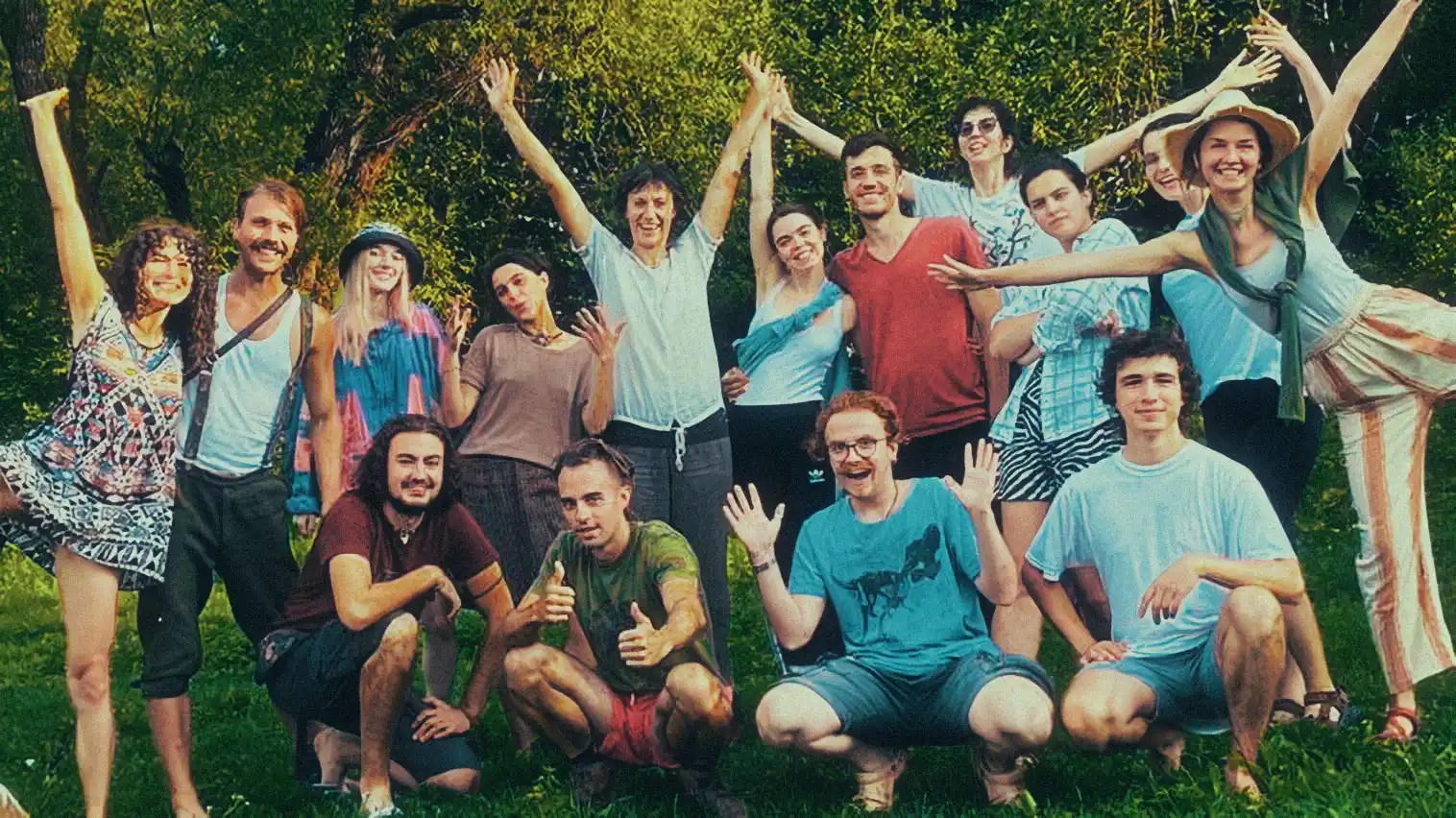
If you have questions before getting started, write to us directly. We are happy to talk.
We also invite you to read these articles

Sources
- Meadows et al., The Limits to Growth, Club of Rome, 1972
- Rockström et al., A safe operating space for humanity, Nature, 2009
- Herrington, G., The Limits to Growth model: still prescient 50 years later, Earth4All Deep Dive, Club of Rome, 2022
- Richardson et al., Earth beyond six of nine planetary boundaries, Science Advances, 2023
- Sakschewski, Caesar et al., Planetary Health Check 2025, Potsdam Institute for Climate Impact Research / Stockholm Resilience Centre, 2025